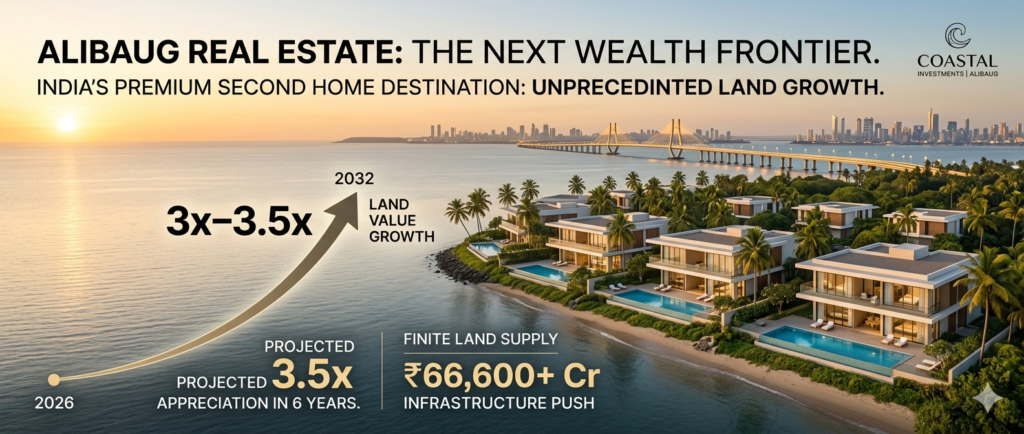
For decades, Alibaug was recognized merely as Mumbai’s sleepy, sun-drenched weekend getaway—a transient escape for the city’s elite. However, the narrative has fundamentally broken out of the lifestyle box. Data from independent real estate research firm Liases Foras reveals a massive market transition: Alibaug land values are projected to skyrocket by 3x to 3.5x over the next 5 to 6 years.
To understand why smart money is aggressively migrating across the harbor, we have to look past speculative hype and focus entirely on the hard economics of land supply and multi-billion-dollar infrastructure shifts.
The Historical Velocity: Numbers Don’t Lie
Alibaug’s land appreciation isn’t a future hypothesis; it is an ongoing reality.
-
In 2018, the average price of land stood at approximately ₹2,884 per sq. ft.
-
By 2025, that figure climbed to ₹7,210 per sq. ft.
-
By 2031–2032, independent forecasts project land values will hit a staggering ₹21,250 per sq. ft.
This compounding momentum is precisely why tier-1 corporate developers like Lodha, Oberoi Realty, Mahindra Lifespaces, and Emaar India have aggressively acquired sprawling acreage here for ultra-luxury gated communities and branded villas.
The Connectivity Compression: Erasing Distance
Historically, the biggest barrier to Alibaug’s growth was accessibility. That barrier has officially collapsed under the weight of over ₹66,600 crore in ongoing and completed regional infrastructure investments:
-
The Atal Setu (MTHL) Effect: The operational Mumbai Trans Harbour Link has dramatically slashed road travel time from South Mumbai down to just 60–90 minutes.
-
The Revas-Karanja Bridge: This critical, committed project will slice commute times from Navi Mumbai down from 2 hours to a mere 30 minutes, seamlessly linking Alibaug to the upcoming Navi Mumbai International Airport.
-
The Multimodal Corridor: The planned Virar-Alibaug Multimodal Corridor will soon bridge the entire northern manufacturing and residential hubs directly to the southern coastline.
When infrastructure compresses distance, it structurally reprices the land asset class. Alibaug is no longer an isolated coast; it is legally and physically becoming a direct extension of the Mumbai Metropolitan Region (MMR).
The Scarcity Dynamic: Finite Coastline vs. Surging Demand
Urban expansion usually creates new land supply. Alibaug’s infrastructure upgrades, conversely, do not create a single new square inch of premium coastal land. Strict Coastal Regulation Zone (CRZ) rules and severely restricted developable “R-Zone” pockets mean the supply side is rigidly capped.
Meanwhile, demand is soaring. Tourist footfalls nearly doubled from 2.2 million in 2020 to 4.5 million, fueling a massive weekend floating population of 50,000+ visitors. For high-net-worth individuals (HNIs), buying clear-title land parcels or managed villas yielding up to 12% in rental returns has evolved from an emotional luxury purchase into a highly calculated portfolio hedge.
The Bottom Line
With major conglomerates transforming local micro-markets like Nagaon and Kihim into eco-luxury hubs, the window for raw capital entry is narrowing. Alibaug real estate is delivering a rare convergence of severe land scarcity, exponential tourism yields, and transformative connectivity. For long-term land banking, the next six years represent the ultimate window before the market fully reflects its true value.